
By Val Thomas • April 28, 2026
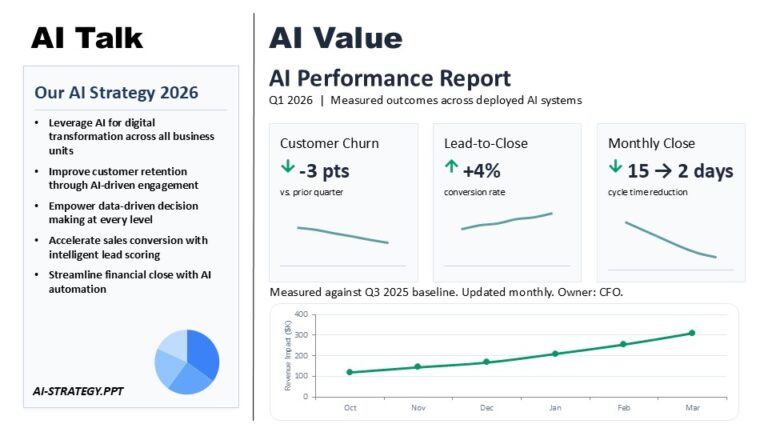
We’ve been in a lot of AI strategy sessions lately, and have seen plenty of strong PowerPoints. The question is no longer whether or not to do AI. It’s now whether what’s underway is living up to its PowerPoint promise. Here are three starting questions to find out if AI is delivering value for you.
1. Where is AI running in production, and how is it being measured?
Production means a workflow that real employees or customers depend on, with a measurement framework that existed before the AI did. A good answer names the workflow, the KPI, and the baseline it moved against. “Customer service handle time, down from 14 minutes to 9, measured against the prior six-month average.” That’s a sentence a CEO can take to the board and a CFO can verify. Pilots don’t count. Demos don’t count. Slide decks claiming “AI-enabled across the enterprise” definitely don’t count.
If a company has one of these measurable workflows, the AI investment is producing value. If it has several, the company has moved from talk to value. If it has none, the AI investment is still in PowerPoint pilot mode.
2. Who owns the ROI answer at the board or executive level?
One person, by name, who can translate what the technology did into what the business gained. Some companies put this on a CFO or COO rather than a CIO, and that can work, depending on the business. What matters is that someone is accountable for the answer, not the technology choices that produced it. The board or owner doesn’t need to hear about model selection or infrastructure. They need to hear what changed in the business and what it cost to change it.
The right owner keeps the conversation on results and next steps. Without one, deployment, budget, and strategy each become separate conversations.
3. What does the AI policy actually cover?
A complete policy covers more than I can fit here, but at minimum it names the approved tools, the data rules that govern what goes into them, the approval path for new ones, who enforces it, and what happens when something breaks. A common mistake is writing what the company wishes it did rather than what it actually does. Once that gap exists, the policy stops being a control and starts being a liability, particularly if a regulator gets involved. The fix isn’t a longer policy. It’s a short, living document that describes current practice and is updated as changes occur.
There are more questions, such as funding, data, and talent, to be sure, but those seem to be the starting three.
I’m curious to hear what others would add.
Originally published on LinkedIn, April 28, 2026.