
By Val Thomas • May 13, 2026
Boards, PE sponsors, and owners are backing AI strategy as strongly as ever, but what’s ended is the willingness to fund it without a clear view of the return. The challenge is that before any framework can produce a credible number, the AI spend itself has to be visible across the company. In most organizations today, it’s not, yet.
AI spend doesn’t behave like prior IT spend. Adoption is appropriately decentralized, with marketing, finance, legal, and operations all running their own initiatives. The traditional view of system cost, the kind that worked for ERP or CRM, doesn’t hold for AI. Pricing has materially shifted from per-seat to consumption-based, and the CFO’s financial picture is now built from a variety of cloud bills, expense reports, embedded fees in software contracts, and most notably, consumption charges billing by the token. Tool and service costs are the focus here. Personnel costs are usually easier to quantify, tool and service costs are not. Pulling it all together takes deliberate effort.
The steps below are easier to list than to execute, because the hard part is organizational, not technical. Here is what my clients are finding valuable:
- Inventory the AI projects in progress across the organization. All of them, formal and informal, not just in IT. Most companies find several times more than they expected, and that finding is itself useful.
- Assign each project an owner. One name, accountable for scope, outcome, and the business case the project is meant to serve. Not a committee. Ownership is the precondition for everything that follows.
Inside each project, identify the AI tools in use and assign each tool a spend owner. The tool owner might be IT, the department running the project, or a blend, depending on how the tool is licensed and consumed. One person, by name, accountable for that tool’s spend, usage data, and renewal decisions.
- Aggregate the spend across cost centers into one number. Finance owns the number, with IT providing the usage data and tool-level detail Finance can’t see from invoices alone. The first version is almost always larger than expected, and the gap is a useful signal about how fast adoption is moving.
A category of tools is starting to emerge here, often called AI FinOps. They aggregate usage and cost data across LLM providers and cloud AI services. It’s early, and most of what’s available today serves engineering-led teams running production AI applications more cleanly than it serves enterprise-wide spend across approved productivity tools. Watch the category, and pilot where the engineering-side spend is already material. Drop me a line if you want to discuss these some more.
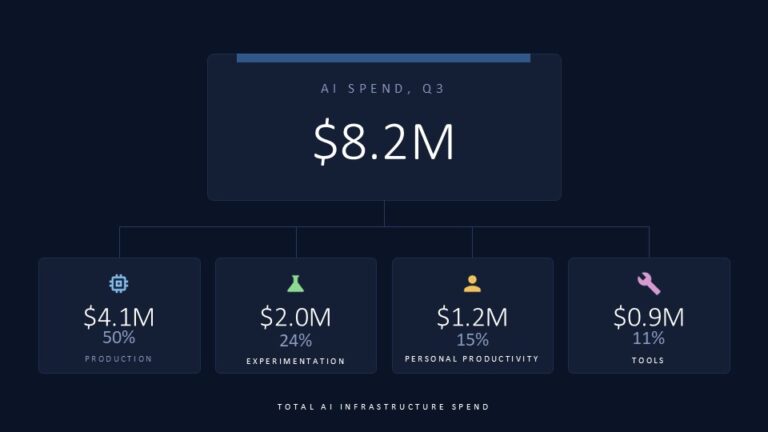
- Classify each project as production, experimentation, or personal productivity. Production means a workflow that real employees or customers depend on. Experimentation means testing whether a tool helps before committing. Personal productivity means individuals using AI to accelerate their own work. All three create value. Only production is a candidate for ROI measurement in the form a board recognizes.
- Consolidate the prior steps into a single view. Spend by project, owned by name, classified by category, totaled by the company.
This is the foundation ROI measurement requires. In “From AI Talk to AI Value” I wrote that production workflows are the only ones that count for ROI. This is the spend side of that same question. With both sides visible, the return question stops being “what did AI return” and becomes “what did this project return, against what it cost.” That is a question a CFO can answer, a board can act on, and a PE or executive team can use to make the next round of funding decisions.
Measuring the actual return on a given production workflow is its own discipline, with its own methodology around baselines, controls, and attribution. This work doesn’t replace that discipline; it completes the cost half of the equation.
Do this work once, maintain it, and ROI on AI stops being hope and becomes math.
Originally published on LinkedIn, May 13, 2026.