
By Val Thomas and Niraj Patel • October 2025
The AI gold rush creates a false dichotomy: adopt everything or get left behind. The real question is where to deploy AI for maximum impact, not whether to use it. Companies building lasting advantage aren’t AI-first, they’re AI-Mature.
As a leader of an entire organization, business unit, product organization, or operational function you face pressure from investors, competitors, and vendors. Your edge comes from selectively embedding intelligence while balancing innovation with proven approaches that build trust, pricing power, and resilience.
The question today is: Are you building AI theater, or competitive advantage?
Think of AI as a strategic investment, not a mandate to transform indiscriminately. The right question is “Where does AI create defensible value in my business?”
Do this by reimagining core functions, not just digitizing them. Here are just a few industry examples from AI-Mature companies:
Insurance Underwriting
- Moving from static scoring models to adaptive systems with early fraud detection and real-time portfolio monitoring that reduce losses.
- Enabling instant pre-qualifications and dynamic pricing that improve conversion while maintaining risk discipline.
- Optimizing funding strategies and sharpening loss forecasting to unlock 200-300 basis points of margin.
- Creating streamlined experiences that differentiate beyond price, the kind that dealers and customers prefer.
Higher Education
- Transitioning from static admissions criteria to adaptive applicant-profiling platforms that integrate academic records, extracurricular signals, and social sentiment for equitable, data-driven selections.
- Enabling instant scholarship matching and dynamic financial aid offers tailored to each student’s profile and projected success likelihood, increasing enrollment conversion.
- Optimizing course planning and resource allocation via predictive enrollment and attrition models, improving retention rates by spotting at-risk students early.
- Delivering personalized learning pathways including AI tutors, real-time feedback dashboards, and auto-scaled content pacing that elevate student experience beyond traditional lectures.
Manufacturing Quality Control
- Evolving from fixed defect thresholds to AI-powered anomaly-detection systems that monitor equipment vibrations, temperature, and output quality in real time, cutting scrap rates.
- Enabling instant quality scoring and dynamic process parameter adjustments (pressure, speed, feed rates) based on continuous feedback loops, boosting first-pass yield.
- Optimizing maintenance and supply-chain strategies through predictive models that forecast part failures and material shortages, unlocking 2 to 4 percent improvement in throughput.
- Creating operator dashboards with proactive alerts, guided troubleshooting, and automated corrective actions that distinguish manufacturers on both quality and agility.
Examples like this can be applied to any complex decision-making whether or not they are under regulatory scrutiny.
Understanding Your Position: The Technical Generational Shift
Most executives manage systems across three generations of technology implementation:
Gen 1, Rules-based systems: Efficient but rigid and can’t adapt to market shifts or customer behavior changes.
Gen 2, Digital enablement: Automated workflows, mobile apps, and APIs. Competitors have similar tools, eroding differentiation quickly.
Gen 3, AI-Mature platform: Adaptive, predictive, trust-centered, and operating in real-time. These are what lead to competitive separation.
Leaders emerging today aren’t just modernizing Gen 2 infrastructure, they’re reimagining core functions through Gen 3 capabilities, requiring executive ownership.
Innovation with Discipline: Building the Trust Foundation
To build AI advantage, strategic deployment rests on four pillars:
- Data Foundations First: Modern, real-time, explainable, and compliant architectures are crucial. Clean and accessible data is non-negotiable; AI amplifies problems if data is flawed.
- Governance Embedded: Governance is embedded to ensure data quality and compliance. Compliance at design-time is crucial, as regulatory frameworks must be integrated, not added later. The cost of failure has escalated from reputational damage to existential risk.
- Platform flexibility is essential to absorb future AI maturity waves without costly re-platforms. Today’s models may become obsolete in 18 months, so your architecture should remain relevant.
- Human oversight is vital, as AI supports decision-making, not replaces accountability. The best systems augment judgment, not eliminate it, especially in regulated environments where explanations are necessary.
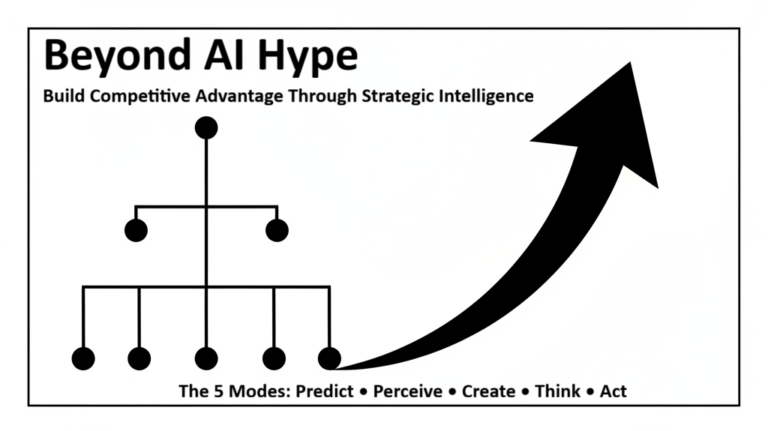
A Framework for Action: The 5 Modes of AI
Understanding AI capabilities requires a mental model. Here’s how to think about AI’s potential for your business:
- Prediction: Classify and anticipate future events. Real application: Fraud detection, demand forecasting, churn prediction.
- Perception: See, hear, and read. Real application: Document intake, voice transcription, visual inspection.
- Creation: Generate new content. Real application: On-brand marketing copy, proposal generation, synthetic data.
- Thinking: Reason through complexity. Real application: Multi-factor pricing, claims adjudication, compliance checks.
- Agentic: Take action. Real application: Workflow orchestration, risk-based approvals, human escalations.
Combining these modes unlocks real power.
Customer Support Example:
AI predicts ticket needs (Prediction), searches knowledge base (Perception), reviews past interactions (Thinking), drafts responses (Creation), and routes for approval (Agentic).
Each mode alone is incremental. Together, they transform both economics and experience.
Use this framework in your next strategy session. Map critical processes against these five modes. Where are you missing value?
The Strategic Payoff: Five Vectors of Competitive Advantage
Companies executing this approach see differentiation across five dimensions:
- Trust: Transparent, explainable approvals win customer loyalty in an era of AI skepticism.
- Capital Efficiency: Sharper balance sheet analytics and optimized funding strategies improve margins by 200-300 bps.
- Cost Advantage: Leaner servicing models free 20-30 percent of capacity for growth.
- Differentiation: Intelligence embedded into customer and partner journeys competes on experience, not just price.
- Resilience: Strong data and compliance foundations become barriers to entry, not just checkboxes. Competitors need 18-24 months to replicate.
From Insight to Action: Your Next 90 Days
If you’re ready to move beyond pilots and vendor demos:
Weeks 1-2: Reframe the conversation. Focus on business outcomes, not “AI strategy.” Identify areas where deals are lost, costs are out of control, and customer experience is broken. AI is the solution, not the problem.
Weeks 3-4: Build shared language. Establish a common understanding of AI and its applications. Run a working session with your leadership team using The 5 Modes framework to map critical processes, identify value gaps, and align on top opportunities.
Weeks 5-8: Focus on high-stakes, regulated, capital-heavy processes like credit decisioning, claims processing, and risk monitoring. These create moats due to their deep domain expertise and compliance rigor.
Weeks 9-10: Emphasize safe speed in communication, not just velocity. Highlight the explainability, compliance, and trustworthiness of AI systems.
Weeks 11-12: Identify adjacent opportunities using AI Mode Matrix workshops. Explore where the same capabilities can be applied and what new business models emerge.
The Takeaway
- The AI revolution isn’t about speed of adoption but about strategic embedding. Companies that view AI as a strategic choice build lasting advantage.
- You’re not behind if you haven’t deployed AI everywhere. You’re behind if you haven’t identified where AI creates defensible value and started building the foundations to capture it.
- In a world with accessible models, your edge lies in knowing where to apply them and having the discipline to prioritize them.
Are you building AI theater, or competitive advantage?
Originally published on LinkedIn, October 2025.